Institute of plasma physics › Structure of IPP › Plasma Chemistry and Materials Division › Pulse Plasma Systems Department › Research Topics › Discharges with Liquids
Electrical Discharges in Liquids and Gas/Liquid Environment
Principles and Research Objectives

Non-thermal plasma generated by electrical discharges in water and at gas/liquid environments is investigated, the physical and chemical processes induced by these discharges in water and their effects on organic compounds and microorganisms. Non-equilibrium plasma generated by electrical discharges in liquids initiate various chemical and physical processes that can be potentially utilized in different environmental, biological or medical applications. Depending on the type of the discharge and the input energy these processes include electric field, ultraviolet radiation, overpressure shock waves and, of particular importance, formation of various reactive chemical species such as radicals (OH•, H•, O•) and molecular species (H2O2, H2, O3). These processes contribute to degradation of organic compounds and inactivation of microorganisms in water by electrical discharge plasma. The main mechanism of plasmachemical decomposition of organic compounds in water involves oxidation processes initiated by OH• radicals, ozone, and hydrogen peroxide (especially in the presence of suitable catalysts such as iron, platinum, tungsten). In the gas-liquid discharge environments, the nature of the gas phase (typically air, oxygen, or argon) affects the formation of chemical products (such as oxygen- and nitrogen-based reactive species), which, in turn, transfer from the gas phase into the liquid and contribute to the plasmachemical processes in water. Reductive pathways induced by H• and superoxide O2•- radicals and molecular hydrogen can take place as well. In the case of microbial inactivation the physical processes from plasma, such as UV photolysis, large electric fields and shock waves, may also contribute.
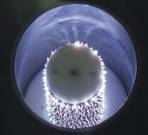
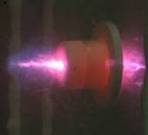
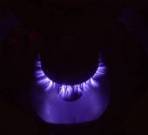
In recent years we have developed several types of electrical discharge reactors of different electrode geometries (point-plate, wire-cylinder, hole-plate) producing electrical discharge either directly in the liquid phase or in the gas phase in close proximity to the liquid surface or in both phases simultaneously (figure below shows some discharge reactors we have developed at IPS Dpt.). Special metallic electrodes covered by thin layer of porous ceramic were developed in order to generate multichannel discharge in water using a wide variety of geometrical configurations, including wire cylinder or planar systems. Porous ceramic coatings were deposited on the surface of metal electrode by thermal plasma spraying of powders of natural raw minerals such as aluminum oxide or iron aluminum silicate (almandine). We have published a number of papers on the plasmachemical processes induced by electrical discharges in water and at gas-liquid interfaces (emission spectroscopy and chemical analyses of reactive chemical species such as radicals H•, O•, OH• and molecular species H2O2, H2, O2, O3), physical processes induced by discharges in water in dependence on the solution conductivity (such as quantitative evaluation of emission intensity of ultraviolet radiation from the discharge and generation of shock waves in water), electron density measurements and electrical breakdown phenomena associated at surface ceramic/electrolyte interfaces. We cooperate in the frame of joint research projects with many research institutions working in plasma physics and chemistry field in the Czech Republic and abroad including cooperations within the International Bioelectrics Consortium.
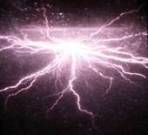 Streamer discharges in water |
Multichannel |
Discharges in vapor |
Discharges in contact |