

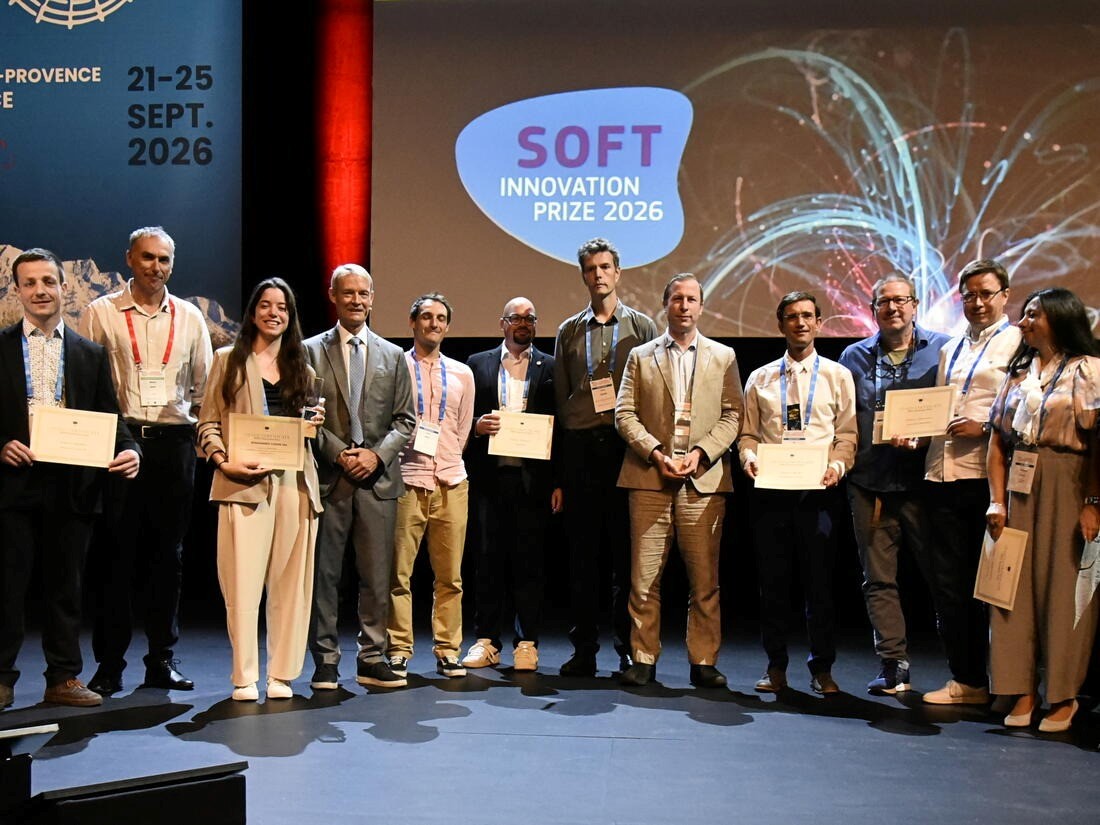
Assoc. Prof. Jan Horáček, together with a team of researchers from IPP Prague, the Institute of Thermomechanics CAS, and the Faculty of Mechanical Engineering at CTU in Prague, was awarded 5th place in the European Commission’s SOFT Innovation Prize 2026 for their innovative STEAM divertor cooling technology, honoring outstanding advances in fusion energy.
One of the greatest challenges on the path to fusion energy is the extreme heat flux imposed on
the reactor’s plasma-facing components. Today’s actively cooled components are typically designed
for approximately 10 MW/m². At higher heat fluxes, their lifetime decreases dramatically, while
around 30 MW/m² it gets immediately destroyed. Future compact fusion reactors operating at higher
magnetic fields may face even greater heat fluxes.
STEAM offers a breakthrough solution. This compact water-cooled system combines a unique
lamellar surface structure, intense nucleate boiling, and a specially designed nozzle for efficient
steam removal.
The results of plasma-torch experiments are remarkable, with no observable damage:
- 80 MW/m² for 20 minutes – a water-tight copper prototype.
- 160 MW/m² for 1 minute – an open diagnostic prototype.
- 100 MW/m² for 2 minutes – a relevant, vacuum-tight prototype.
For comparison, the radiant heat flux at the Sun’s surface is approximately 63 MW/m²! For
imagination, STEAM could even survive on the surface of the Sun—provided we could somehow maintain
a continuous supply of liquid water.
What is the secret?
Conventional water cooling under extreme heat loads encounters the so-called critical heat flux
(CHF) phenomenon, where an insulating steam layer forms, severely reducing heat transfer and
potentially causing rapid material failure.
STEAM appears capable of significantly suppressing this phenomenon, although the exact physical
mechanism still awaits direct experimental confirmation.
The results suggest a fundamental shift: the ultimate cooling limit may no longer be boiling
itself, but rather heat conduction through the cooler’s front wall.
In other words, “the thinner, the better”—as long as the structure does not mechanically
collapse!

27 Oct 2026


