

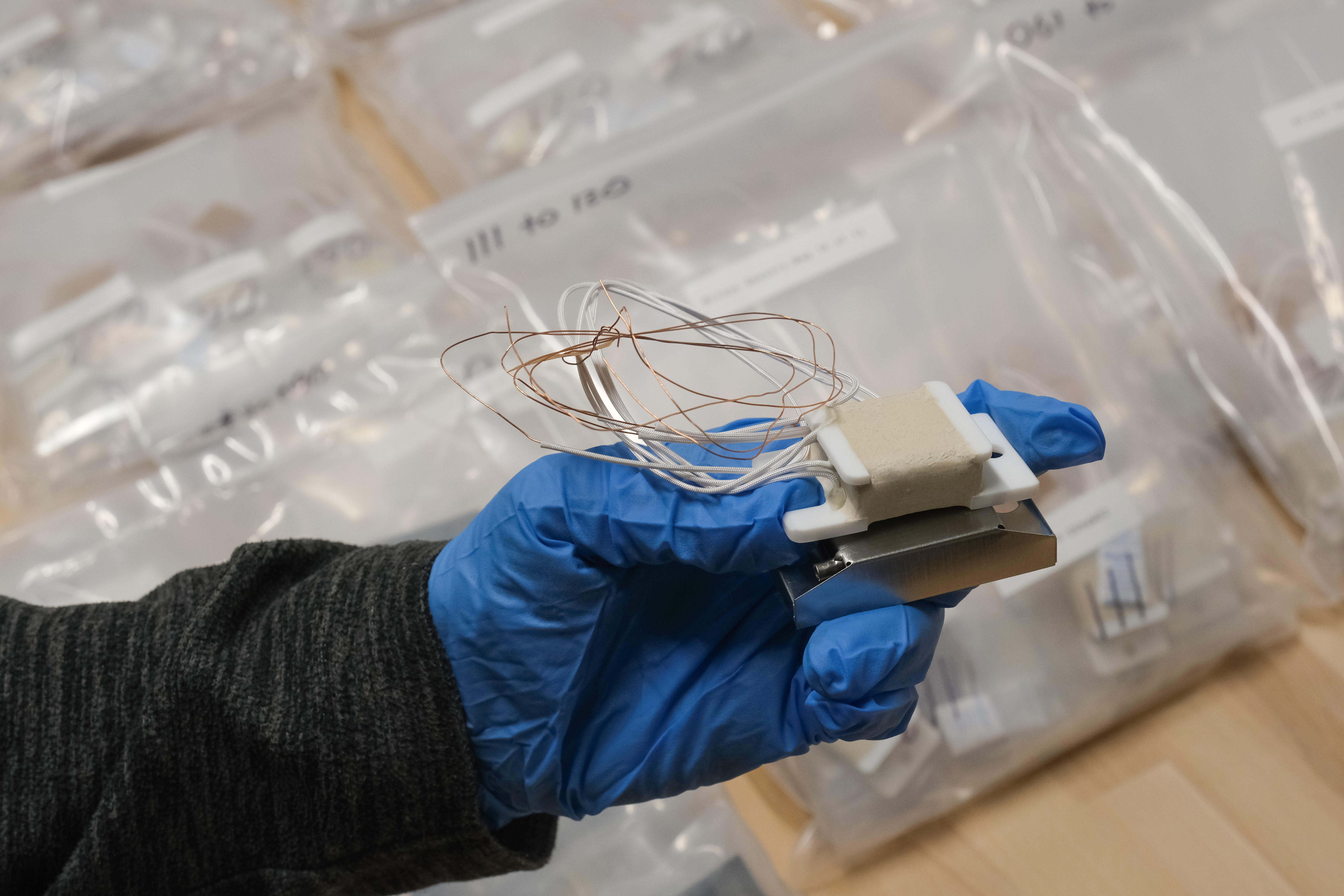
Building a nuclear fusion reactor requires precise instruments that can withstand extreme conditions. Within the scope of the Implementing Agreement between the Department of Energy of the United States of America (DOE) and the Czech Academy of Sciences for science and technology cooperation, the Princeton Plasma Physics Laboratory has stepped in to address this challenge by proposing a project named “COMPASS Upgrade collaboration - Mirnov sensor fabrication” to the DOE.
In summer 2023 this started an intense collaboration between the
PPPL and Institute of Plasma Physics of the Czech Academy of
Sciences (IPP), which just bore the first fruit when these crucial diagnostics sensors for the
upcoming COMPASS Upgrade tokamak arrived at IPP.
The delivery consists of fast magnetic field detection coils, known in the fusion community as
Mirnov coils. Inside the tokamak, these sensors act as an early warning system. They measure
high-frequency fluctuations in the plasma, helping scientists to detect instabilities that could
disrupt the plasma discharge. Furthermore, their measurements are vital for reconstructing the
exact position and shape of the hot plasma column.
These sensors are among the first systems destined for the interior of the vacuum vessel. Before
installation, the engineering team will subject them to strict testing. Other than undergoing
precise calibration in the near future, the coils have already been stress-tested via exposure to
high-power microwave radiation at a 2.1 mm wavelength at the W-7X facility in Greifswald and proven
that the coil shielding can handle the hostile environment inside the COMPASS Upgrade vessel.
Global partnerships drive fusion research forward. This contribution from Princeton directly enhances the diagnostic capabilities for the upcoming experiments in Prague.


Photo: IPP.
7 Sep 2026


